 |
 |
 |
 |
 |
 |
 |
 |
 |
- Metric System Refresher (Video Tutorial)
- Calculator Tips (TI 80, TI 83, TI 30x)
- Here are some thoughts on why you absolutely, positively shouldNOT use the ^ key in scientific notation calculations
 (NOTE: Newer TI calculators MAY have fixed this, but still... DON'T USE THE HAT KEY!
- Here are some thoughts on why you absolutely, positively shouldNOT use the ^ key in scientific notation calculations
- Scientific Notation Refresher
► SIGNIFICNT FIGURES (Sig Figs)
- SIG FIGS explained (Written Tutorial Using "Coming To North America Method")
- Sig Figs Basics (Video Tutorial)
- SIG FIGS Online Practice
- Railroad Tracks Explained (Written Tutorial)
- RR Trax with Sig Figs Basics (Video Tutorial)
- RR Trax Basics (Video Tutorial)
- RR Trax Advanced (Video Tutorial)
► GRAPHING MOTION
- Interpreting Displacement Vs Time Graphs (basic)
- Interpreting Displacement Vs Time Graphs (advanced)
- Graphing Instantaneous Velocity an Acceleration with Tangent Lines
- Solving for Average vs Instantaneous Velocity (annotated solved problem)
- Motion Problems (in one dimension) at the Physics Classroom Website
NOTES:
- Problems up to #17 are mostly graphical analysis such as slope and area-under-the curve
- Problems #18 and thereafter are horizontal OR vertical motion problems using our main equations of motion
- Problems in BLUE font are a wee bit nasty!
► Mr W annotated solutions for problems #18 and above are HERE
► Motion Study Worksheet Problems
| Type | Difficulty |
Problem Description & Link to Solutions |
| Horizontal Motion | ||
| Vertical Motion | Various |
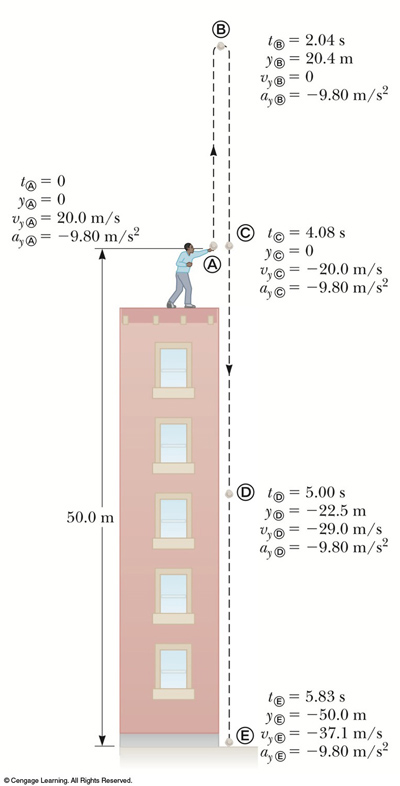
This graphic is VERY helpful. Pick a position (A-E) and calculate the values (height, time, velocity etc...) found at that point using the initial conditions shown; and then use the image to check your work! |
| Vertical Motion | Basic |
Physics Classroom Problem #25: Falling Object. |
Vertical Motion Part I |
Basic |
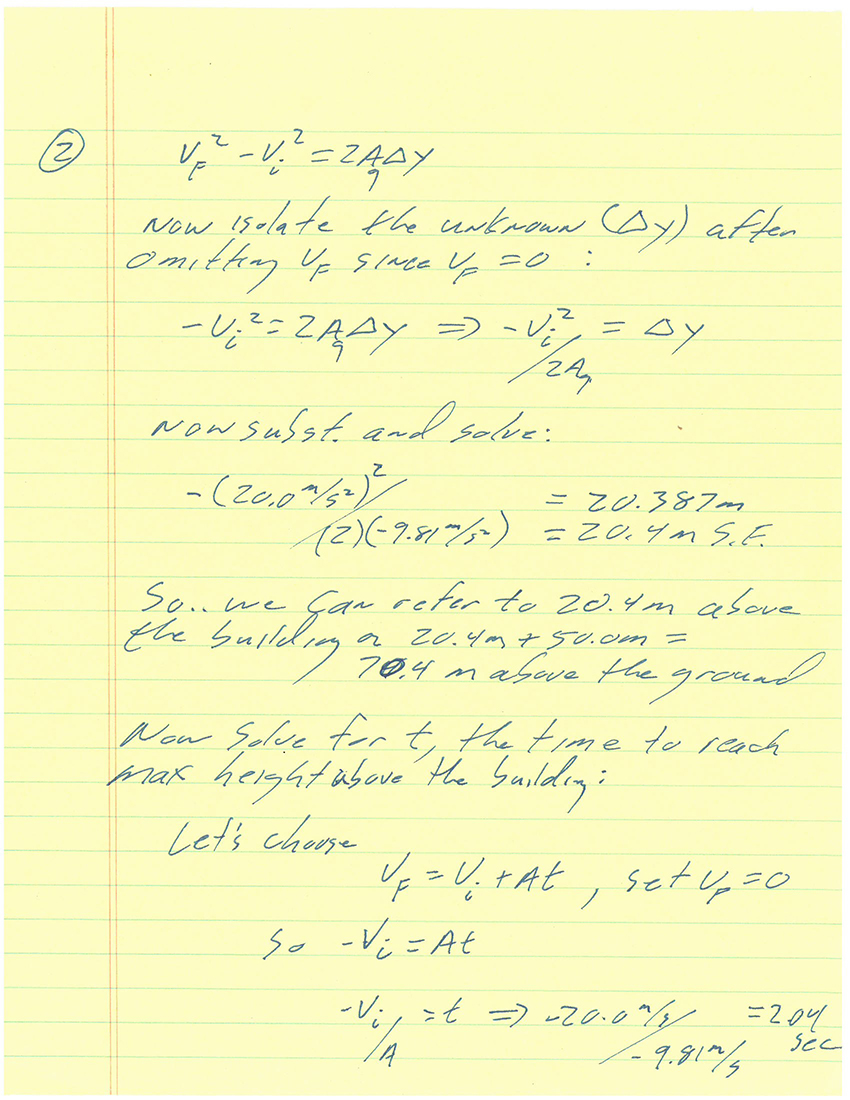
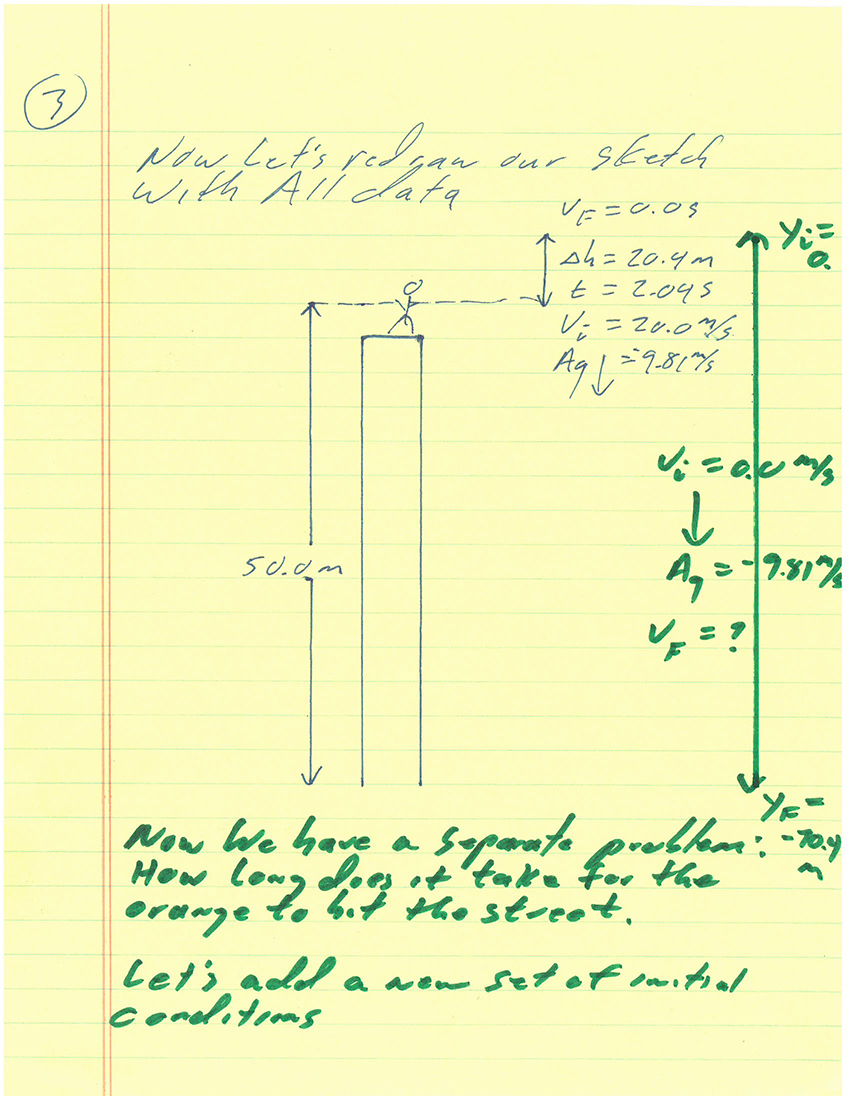
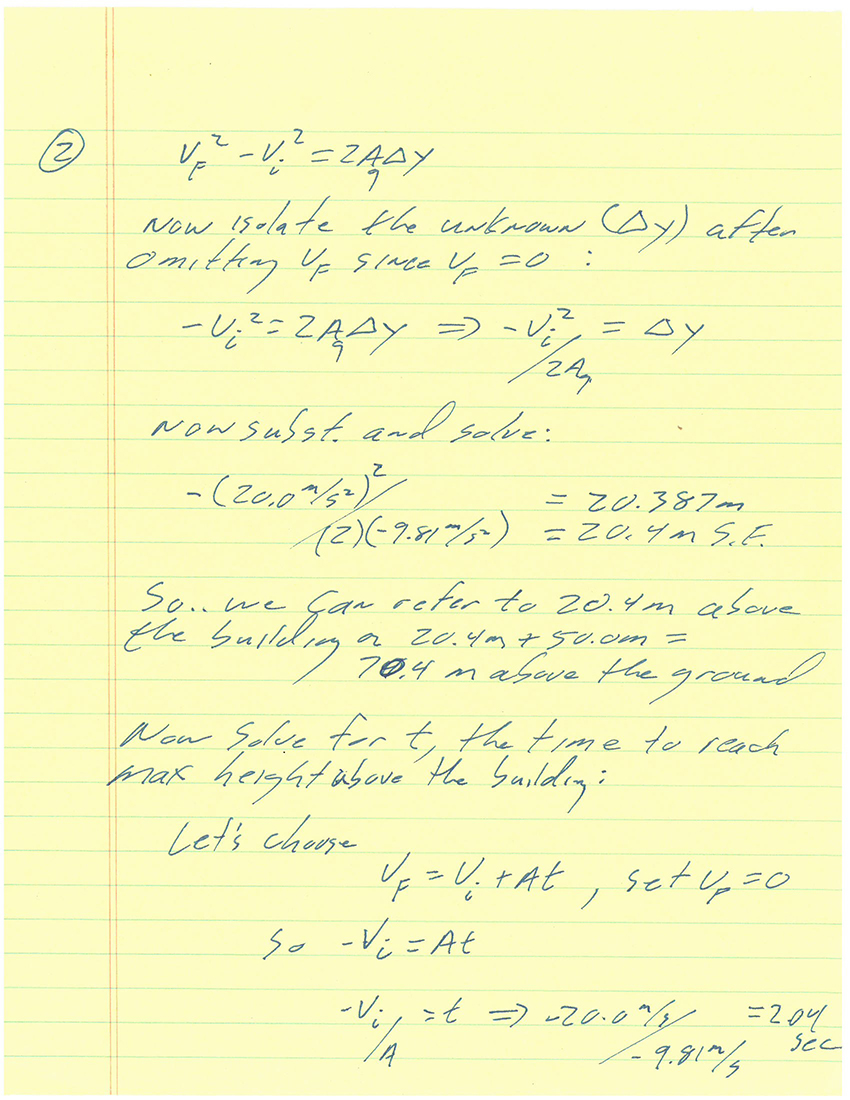
An orange is thrown directly upwards from the top of a 50. m building with an initial velocity of 20.0 m/s. How long is the orange in the air? How high above the building does it go? SOLUTION |
Part II |
How long does it take the orange to reach hmax? SOLUTION | |
Part III |
How long does it take for the orange to fall from hmax? SOLUTION | |
| Projectile Motion | Basic
|
An object is launched from ground level with an initial velocity of 25.3 m/s at an angle of 37o to the horizontal. How high does the object go? SOLUTION |
| Projectile Motion | Basic |
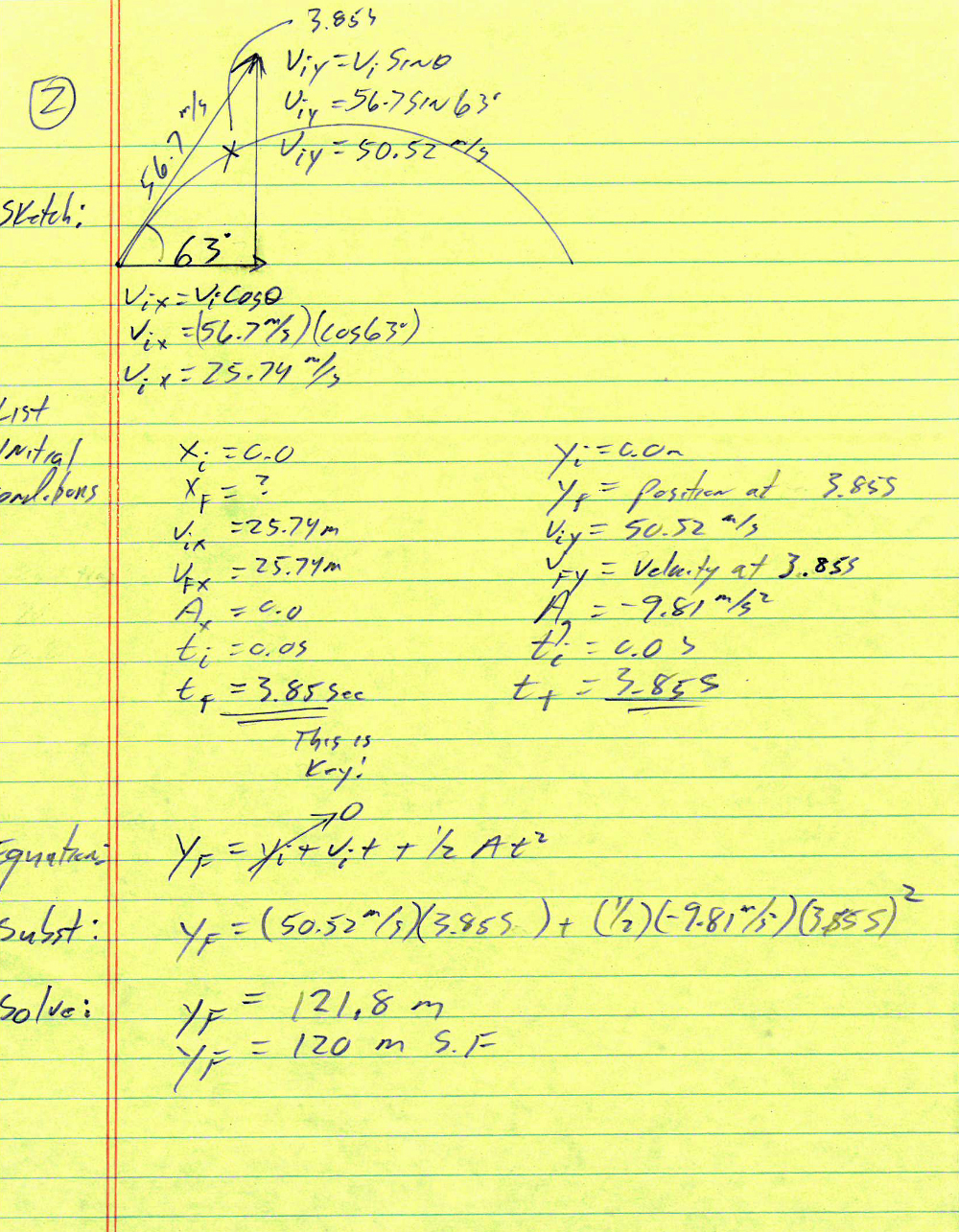
An object is launched from ground level with an initial velocity of 56.7 m/s at an angle of 63o to the horizontal. How high does the object go? SOLUTION |
| Projectile Motion | JV |
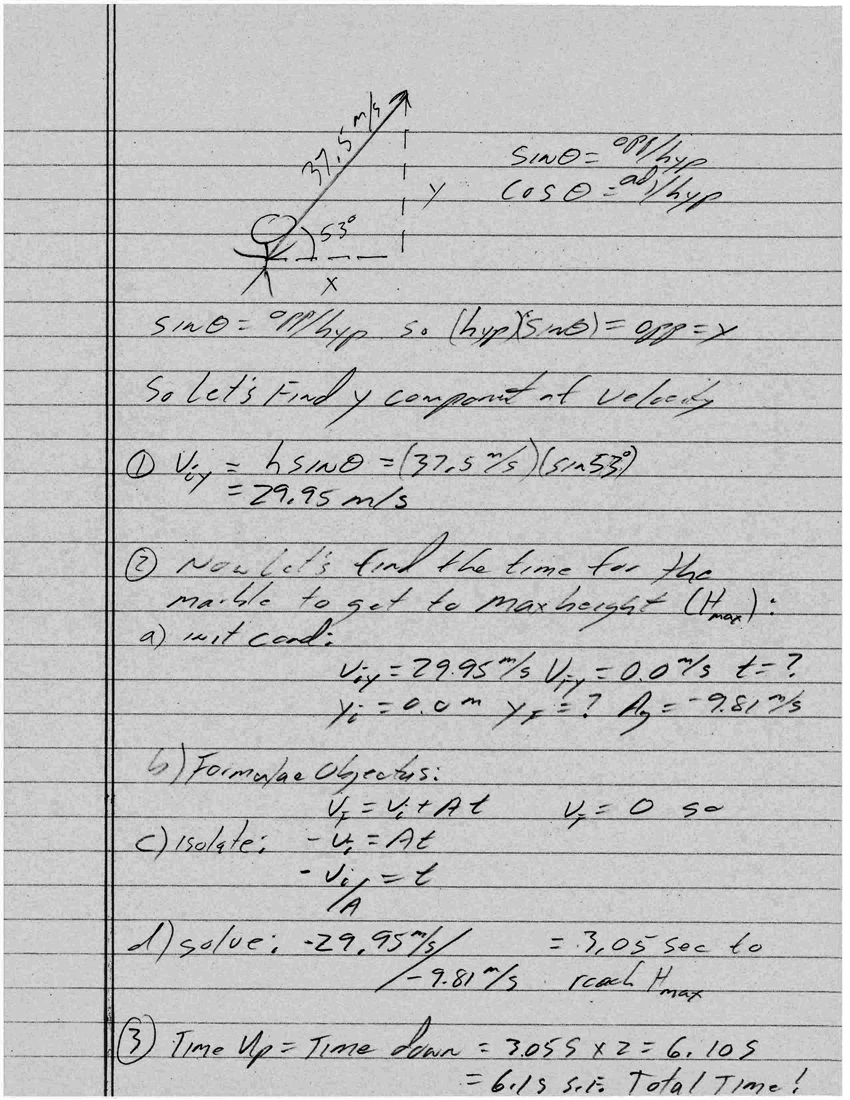
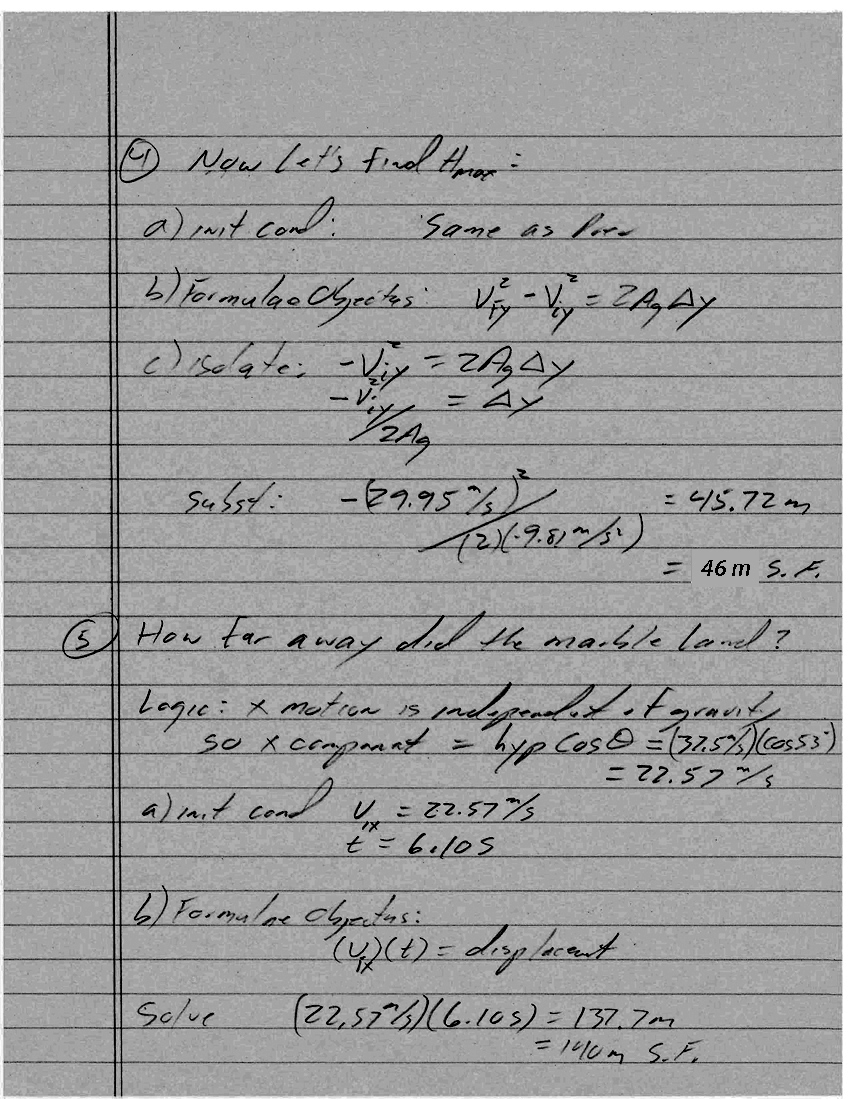
Part I: A marble is launched from a sling shot at ground level with an initial velocity of 37.5 m/s at an angle of 53o to the horizontal. How long is the marble in the air if it lands at the same height at which it was launched? SOLUTION Part II: How high does the marble go? Part III: How far away does it land? SOLUTION |
| Projectile Motion | JV
|
|
Projectile Motion Part I |
JV
|
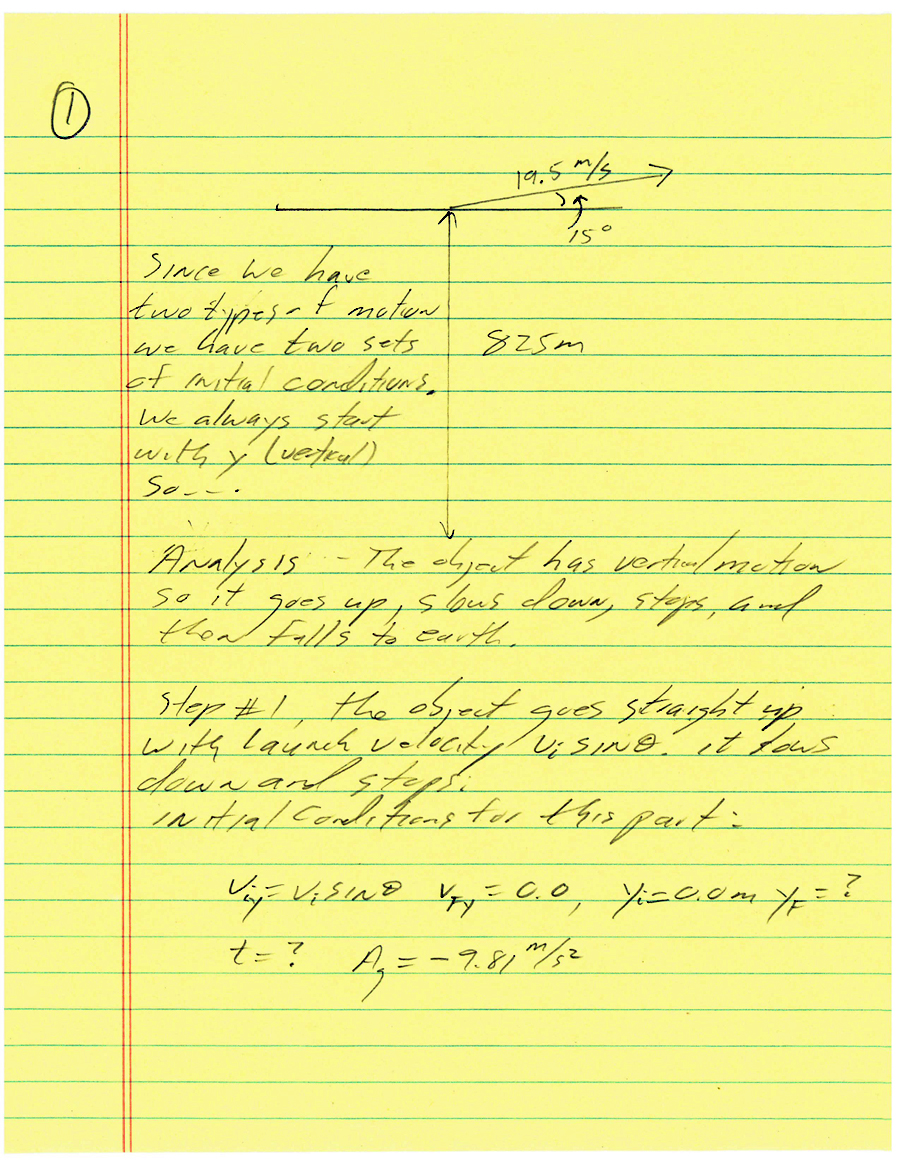
A person throws a rock from the top of an 825 m cliff with an initial velocity of 19.5 m/s at an angle of 15o to the horizontal. We want to know how far away it falls (horizontally from the bottom of the cliff. Setup that situation: SOLUTION |
| Part II | JV |
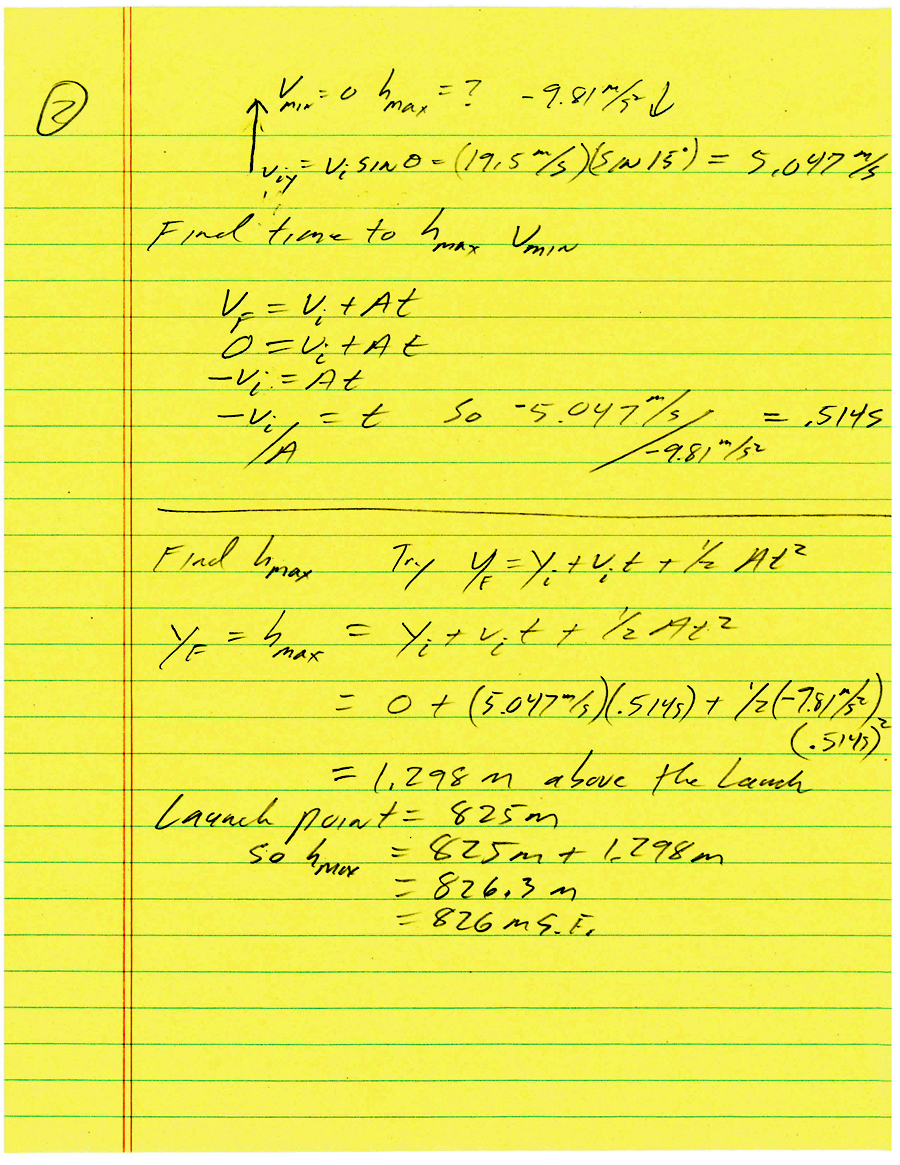
Find time to hmax and show how you can use that in the quadratic equation to find hmax: SOLUTION |
| Part III | JV |
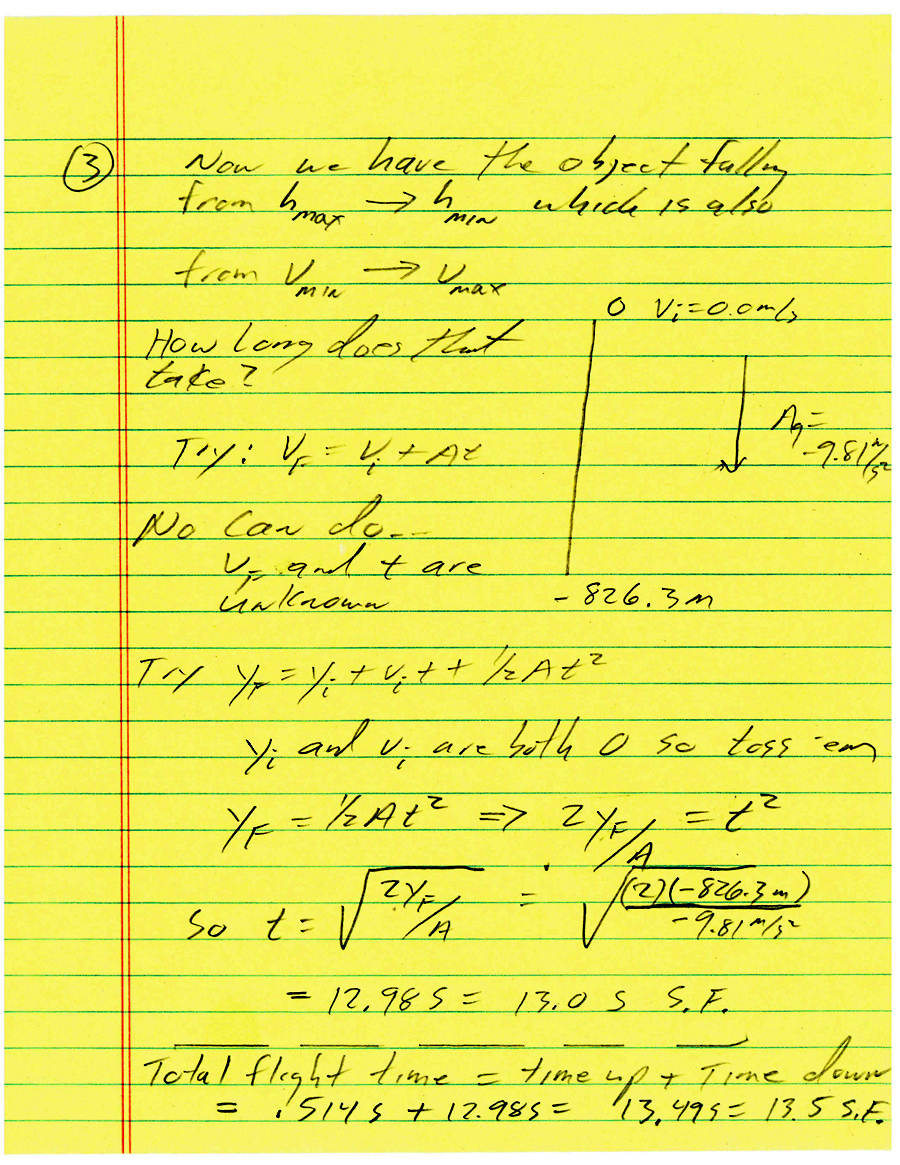
Find time for the rock to fall from hmax. We'll combine that with the time to reach hmax we found in Part II (above) to find the TOTAL time the object is in the air. SOLUTION |
| Part IV | JV |
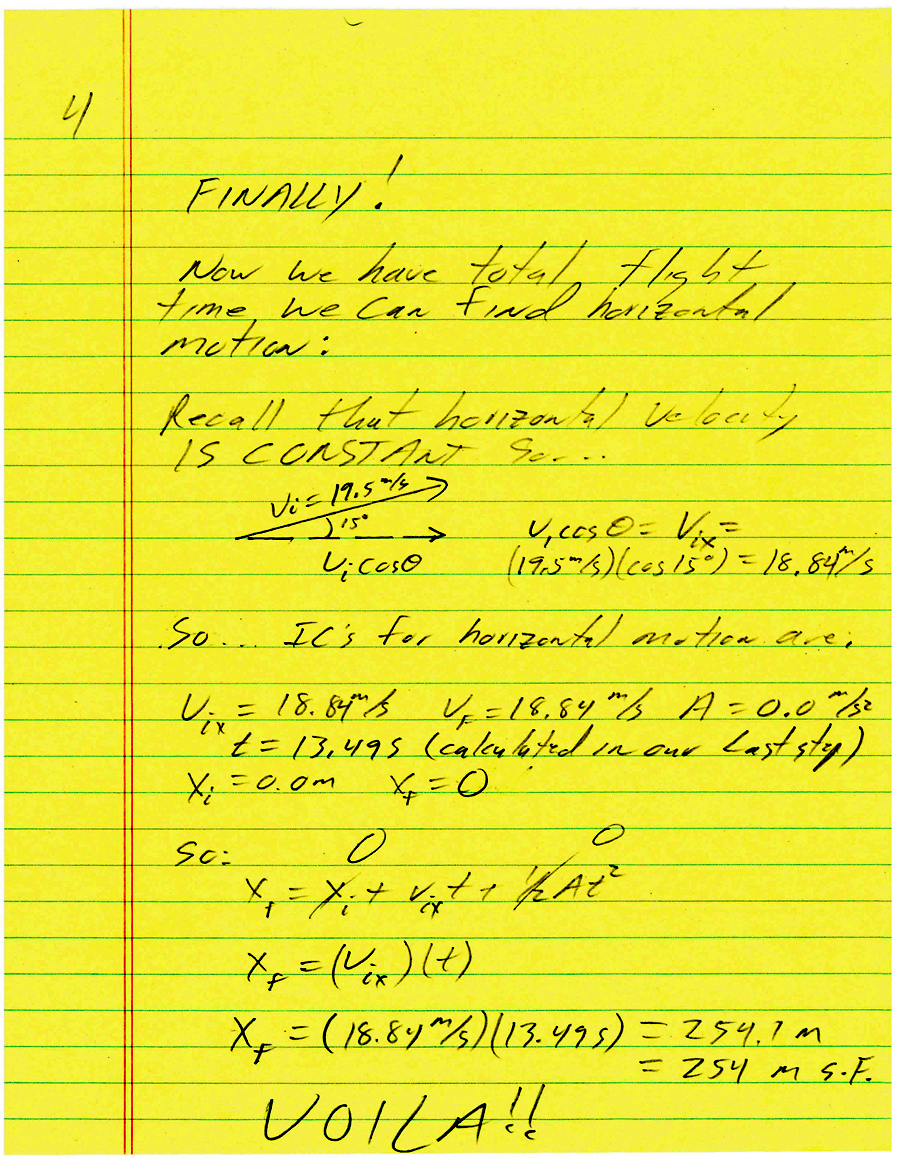
Now that we have the total time the rock is in the air we can find out how far away (horizontally) that it lands SOLUTION |
| Projectile Motion | Varsity |
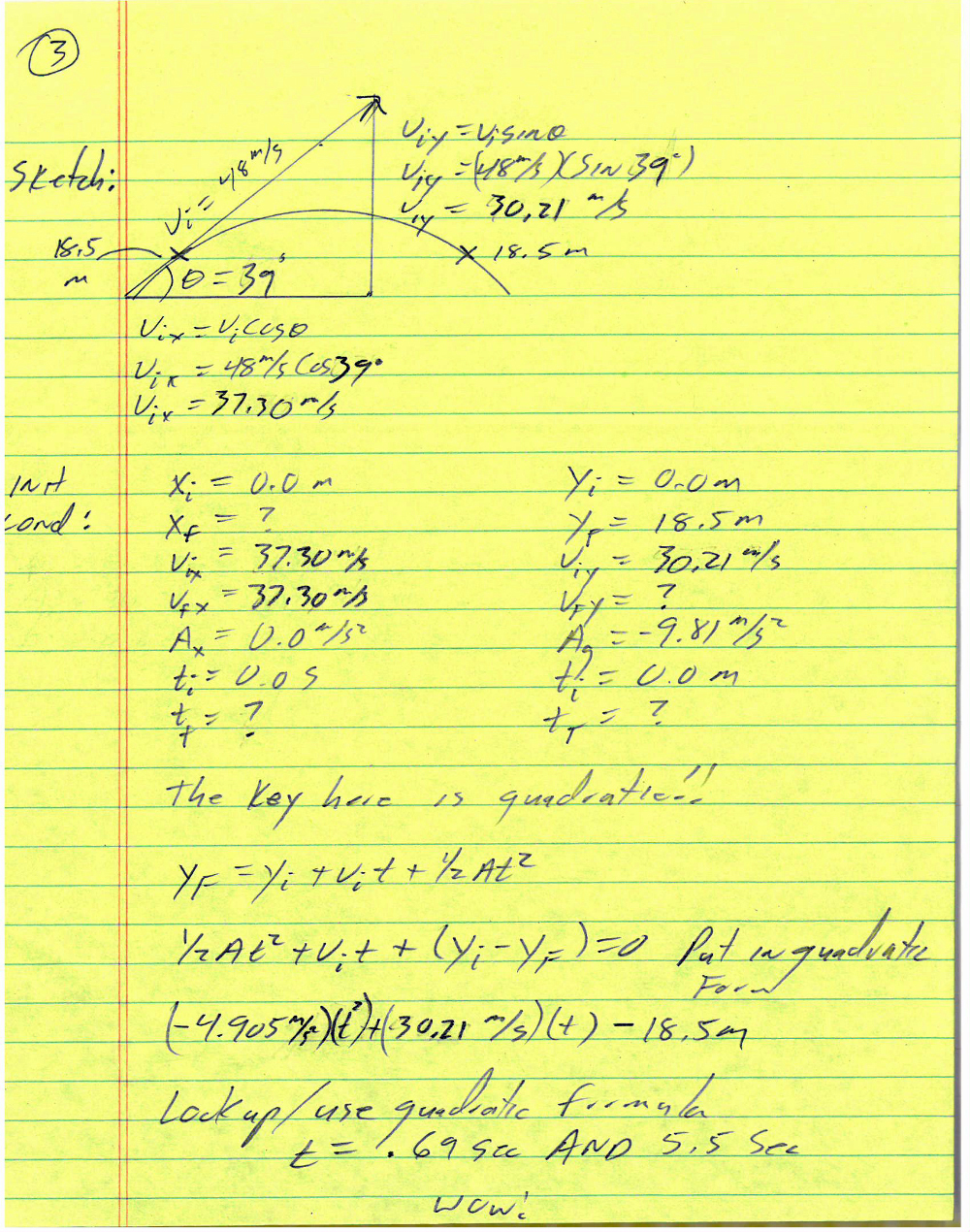
An object is launched from ground level with an initial velocity of 48 m/s at an angle of 48o to the horizontal. When is the object's height 18.5 meters (assume the object lands at ground level)? SOLUTION |
| Projectile Motion | Varsity |
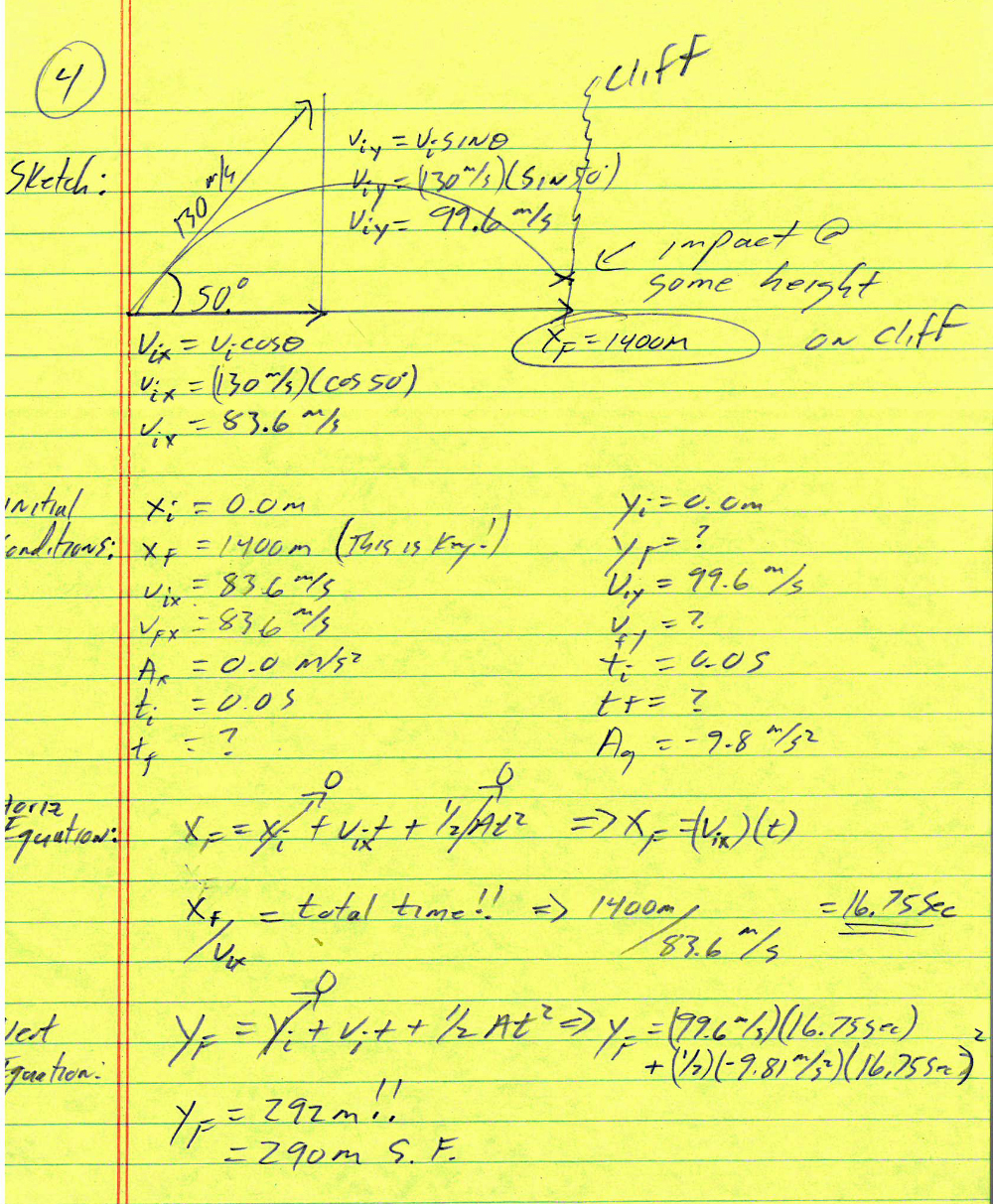
An arrow is shot from the bottom of a canyon. The far wall of the canyon is 1400 m away and rises vertically. The initial velocity of the arrow is a speedy 130 m/s and it launches at an angle of 50.o to the horizontal. How far up on far canyon wall does the arrow hit the canyon wall? SOLUTION |
| Proj Motion Test | Carious | Here are my SOLUTIONS |
VIDEO SOLUTIONS |
||
Vertical Motion - Basic |
Dropping an object (No initial velocity): Video Solution is | |
Vertical Motion - JV: |
Launching an object with vertical velocity: Video Solution is HERE Part II: Video Solution is HERE |
|
| 1st Projectile Motion Test | My Video Solution is HERE | |
| Projectile Motion from the Top of a building | My solution is HERE | |
ADDITIONAL RESOURCES |
||
| Try Kahn Academy- They have worked video solutions | ||
| Our Textbook has a few projectile motion problems - See ~ Page 143 | ||
► Momentum and Impulse are defined HERE
► The Law of Conservation of Momentum is discussed HERE
► Khan Academy Discussion of Elastic & Inelastic Collisions is HERE
► Additional Momentum & Impulse Practice Problems (with hints and solutions) are HERE
My solutions and/or comments to selected problems are HERE
► Khan Academy has a helpful video on centripetal force
► Our good friends at Georgia State University 'Hyperphysics' web site describe centripetal motion rather succinctly (with an emphasis on the math)
► Worked problem set is here (courtesy of the physics classroom web site)
► HERE's how they teach it in University Physics (That's the 'weeding out' class that ALL engineers, chemists and other physical scientists MUST pass. It is usually taken in the freshmen or sophomore years. It is so difficult that some colleges and universities offer 50% more credits (1.5 semester credits vs 1.0 semester credits) for that class.
⊗ Water Waves - You should be very comfortable with understanding how these waves are generated and their general/defining characteristics
► Ocean Waves - Storms/Wind
► Tsunamis - Landslides and earthquakes
► Megatsunamis - Mega-landslides and asteroid strikes (we won't cover these)
⊗ Earthquake Waves - You should be very comfortable with understanding which of these waves cause damage, and simple characteristics of each
►Primary Waves
►Secondary Waves
►Surface Waves
⊗ Electromagnetic Waves - You should be comfortable identifying the defining characteristic of each type of wave. You should be comfortable explaining how each type of light is generated HERE ON EARTH.
► Radio - Usage: Radio waves are used for sensing and long range communication.
How we create radio here on Earth: I refer you to electra-the-electron
═══════════
► Micro - Usage: Microwaves are used in direct line communications, microwave ovens and other areas.
How we create microwaves here on Earth: Humans generate microwaves in lots of different ways. Just to be a wee bit nasty I asked you to research how microwave ovens produce microwaves... it's MORE than a wee bit tough to research.
═══════════
► IR - Usage: We often experience IR light as heat. The nerve receptors in our bodies have evolved to sense IR photons as heat. We also use IR in heat sensing technologies.
How we create IR light here on Earth: I refer you to electra-the-electron
═══════════
► Visible - I refer you to electra-the-electron
► UV - Usage: We experience UV in tanning beds. The bad news is that light damages skin (there's no such thing as a 'healthy tan' -- ask your doc. really.)
How we create UV light here on Earth: I refer you to electra-the-electron
═══════════
► X-ray - Here is a GREAT source describing how we produce x-rays. Here's another helpful source.
► Gammas - oddly enough, 'dummies' can be a helpful search term to use when looking for complex information. This 'for dummies' article is a little bit technical but well worth a read.
►Total Internal Reflection Animation is HERE
►General Help Drawing Light Rays Reflecting off Mirrors is HERE
►Help Drawing Rays Reflecting off CONCAVE Mirrors is HERE
►Help Drawing Rays Reflecting off CONVEX Mirrors is HERE
► Click HERE to see a Khan Academy lecture on Concave Lenses
► Click HERE to see a Khan Academy lecture on Convex Lenses
My Black Hen Lays Eggs in the Relative When
She won't lay them here
(in the probably now)
Because she's unable to postulate how.