
- Despite it's rather intimidating name, trigonometry is simply the study of the relationships between the angles and the sides of right triangles.
- There are three main functions in trig: sine (sin), cosine (cos) and tangent (tan).
- There are three insignificant functions in trig: secant, cosecant and cotangent. These are kind of redundant functions and simply represent the (1/cosine, 1/sine and 1/tangent) values of the main function listed above. Forget about them... well at least for now. We will *rarely* if ever use them, and you'll figure them out when and if....
- Each of the main function in trig relates the ratio of two sides of a right triangle to the angle between those sides.
- The side of a right triangle opposite the 90 degree angle is the hypotenuse
- Because one angle of a right triangle is always 90 degrees, the other two angles of a right triangle must measure more than 0 degrees and less than 90 degrees
- In calculations using trig, we almost always use one of the other two angles (not the right angle)
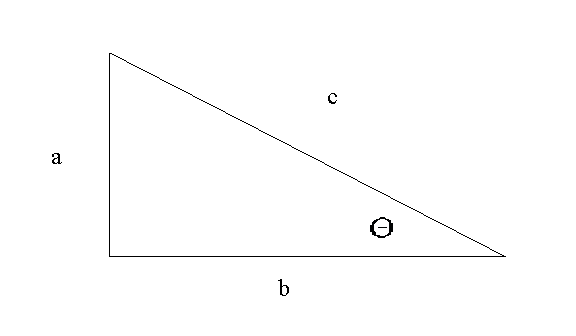
Consider the right triangle above
- note the right angle (90 degrees) between sides a and b
- note sides of length a and length b, with hypotenuse of length c
- note angle "Θ" (It's customary in science & math to use the Greek letter "theta" (Θ) to represent angles)
- sin(Θ) is defined as the ratio of side opposite angle Θ (side a) to the hypotenuse (side c): therefore sin(Θ) = a/c
- cos(Θ) is defined as the ratio of the adjacent angle Θ (side b) to the hypotenuse (side c); therefore cos(Θ) = b/c
- tan(Θ) is defined as the ratio of the side opposite angle Θ (side a) to the side adjacent to angle Θ (side b). Therefore tan(Θ) = a/b
═══════════════════════════
sohcahtoa (pronounced sew-kah-toe-ah) can be helpful. It stands for Sine = Opposite over Hypotenuse, Cosine = Adjacent over Hypotenuse and Tangent = Opposite over Adjacent
═══════════════════════════
If we know the angle of a right triangle and just one of the other sides we can find the lengths of the other sides.
Check this out!
Let's say that angle Θ above is actually 30 degrees. And we know that the length of side a = 10 meters.
Using the definition above, we know that sin(30 degrees) = length of the side of the triangle opposite angle Θ divided by the length of the hypotenuse.
Writing that using math terms, we get:
sin(Θ) = a/c.
If we plug in the angle we know (30 degrees) and the length of side a, we get:
sine(30 degrees) = 10 meters/(length of hypotenuse)
plugging in sine(30) into our calculator:
we get a value of .5
Substituting above:
.5 = 10 meters/(length of hypotenuse)
substituting the letter c for the (length of the hypotenuse) we get
.5 = 10 meters/c
and solving for c we get
.5c = 10 meters
c= 10 meters/.5
c=20 meters
In physics, we frequently talk about the magnitude of a vector. That magnitude is frequently the hypotenuse of a triangle and often symbolized as R. As such, we can often calculate the x component of that vector by Rcos(Θ) while the y component of the vector is calculated by Rsin(Θ). Where Θ is the angle between the vector and the x axis.
INVERSE FUNCTIONS
Once again the terms are somewhat more intimidating than the functions. Inverse trig functions simply relate known sides to angles.
In physics we sometimes know the sides of a triangle but the angle between them is unknown.
For example. In the example above. If we knew the side opposite angle Θ was 10, and we knew the hypotenuse was 20 then we would write the information we know like this:
sin(Θ) = 10/20
sin(Θ) = .5
Our thinking would be:
"There is an angle Θ where the ratio of the side opposite angle Θ to the hypotenuse is equal to .5"
using the inv button on our calculator together with the sin button we type in:
(.5)(inv)(sin)
AND VOILA!!! Out pops 30 degrees!!
TRIG IN PHYSICS
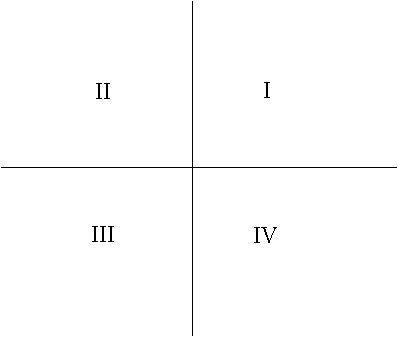
- We always label angles in trig begriming on the positive x axis
- Positive angles are measured counter clockwise from the positive x axis
- FOR EXAMPLE:
- Moving from a point on the positive x axis to a point on the positive y axis involves a movement of 90 degree
- Continuing to move to a point on the negative x axis involves another 90 degree turn resulting in a 180 degree movement
- Continuing to move to a point on the negative y axis involves another 90 degree turn resulting in a total of 270 degrees
- A final 90 degree turn brings us back to where we started from, for a total of 360 degrees.