
OPENING QUESTIONS:
Sketch an example of retroreflection occuring inside a sphere.
Sketch an example of retroreflection occuring inside a cube.
What (do you suppose) is refraction? Draw a sketch of what you *think* might be involved.
═══════════════════════════
LEARNING TARGET: I will be able calculate the index of refraction as a light ray moves between two different media after today's class.
FORMULAE OBJECTUS:
Index of Refraction: c/v = n
Snell's Law: n1sin Θ1= n2sinΘ2
Notes:
c = the speed of light = 3.00 x 10⁸ m/s
n = index of refraction (a unitless value, usually to two decimal points)
v = the speed of light in some medium other than air (like glass or plastic or diamonds or some such)
WORDS O' THE DAY:
- medium (material through which light is traveling)
- Reflection ("Light waves bouncing off an object")
- Emission ("Light is given off by an object")
- Absorption ("Some wavelengths of light are absorbed by an object")
- Angle of Incidence ("The angle a light ray takes as it moves toward a reflecting surface")
- Angle of Reflection ("The angle a light ray takes as it moves away from a reflecting object")
- Retroreflection ("incident light waves are 'double bounced' back to the observer, regardless of the angle of incidence")
- Refraction ("The degree in which a light ray bends as it moves from one medium to another")
- Incident Ray ("Incoming light ray")
- Reflected Ray ("Outgoing light ray")
- Refracted Ray ("Outgoing light ray")
WORK O' THE DAY:
- What is this?
θi = θr
Hopefully you recognize that as the Law of Reflection... when light is reflected from a surface, the angle of incidence (the incoming light ray) = angle of reflection (the outgoing light ray).
We make use of this everyday... for example you set the mirrors of your car using this law and I bet you didn't even know it!
═══════════════════════════
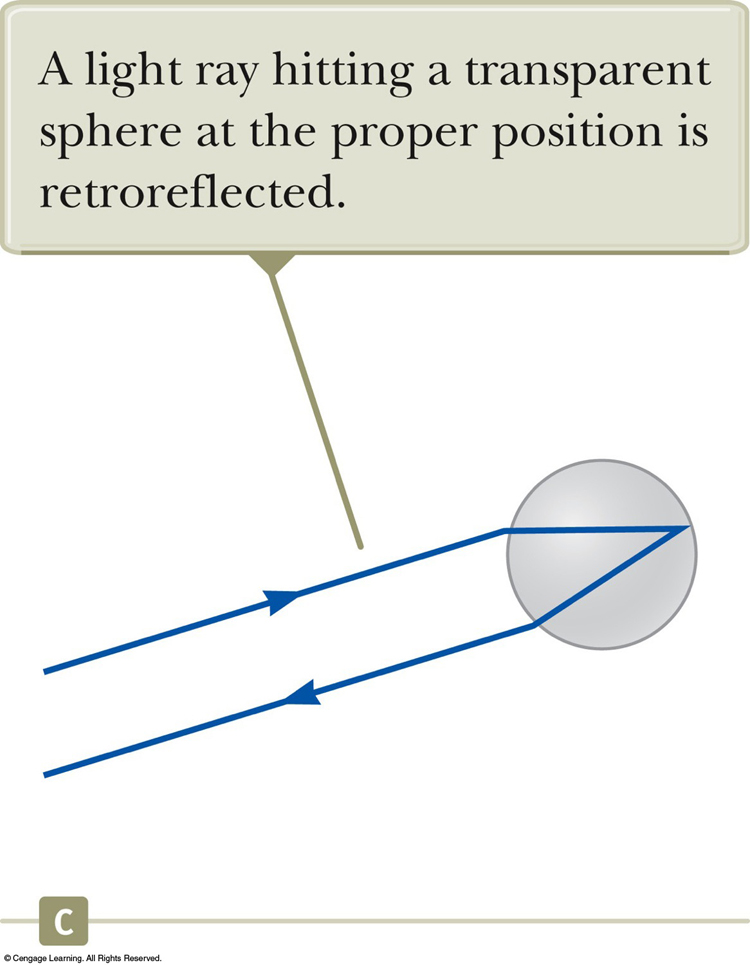
Here's an example of retroflection involving a spherical reflector. Notice that in this case, the light bends as it enters the reflector. Why is that? (Please discuss)
Answer:
The light REFRACTS bends as it goes from one medium (such as air) into another medium (such as glass or plastic)
═══════════════════════════
Let's take a closer look at how refraction occurs.
I absolutely love this "barrel example" and it is used extensively in physics classes to teach refraction using something from our day-to-day lives (a barrel) to explain something that we experience, but cannot directly see (a light ray)
Please take a gander at the following image:
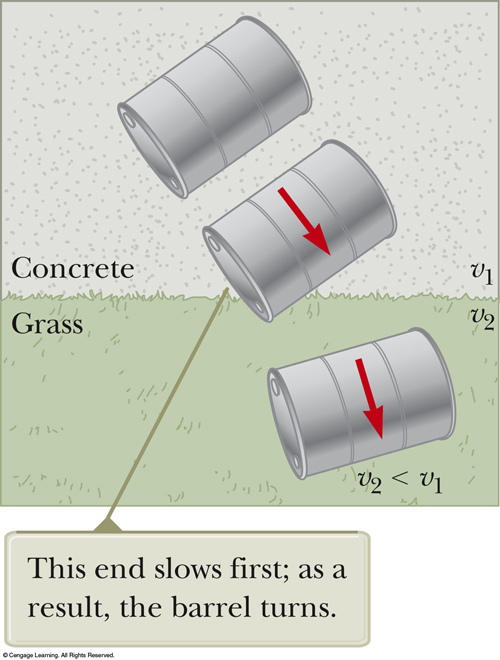
Please have a conversation with your group:
Why is this image such a great analogy to light waves changing speed as they move from one medium (for example air) into another medium (such as water)
There is a specific measurement that indicates how much light speeds up or slows down when passing from a vacuum into that medium, we call that the index of refraction.
NOTE: The speed of light in air is VERY NEARLY the same as the speed of light in a vacuum. In fact, it is so close that we usually use the same value for both and we refer to the speed of light as "c".
- c = 3.00 x 10⁸ m/s and you need to know that NOW (and forever!)
═══════════════════════════
The index of refraction is the ratio of the speed of light in a vacuum (3.00 x 10⁸ m/s) compared to the speed of light in that particular medium:
n = c/v
Where c is the speed of light in a vacuum (3.00 x 10⁸ m/s) , v is the speed of light in some other medium (such as glass or water) and n is the index of refraction in that medium
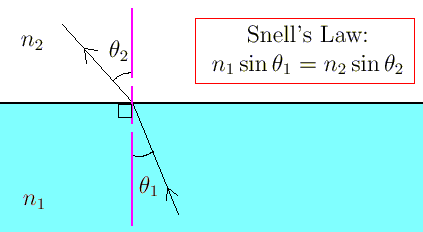
That brings us to this VERY helpful relationship known as "Snell's Law":
n1sin Θ1= n2sinΘ2
1) Please write out an explanation of why the barrel example above is such a great way to visualize refraction (1 thoughtful paragraph should do it!
2) Now please use the definition of the index of refraction together with Snell's Law to derive a relationship between the speed of the incident light ray (v1), the velocity of the refracted light ray (v2), the angle of the incident ray (Θ1) and the angle of the refracted light ray (Θ2).
Now let's try some practice
═══════════════════════════