PHYSICS - HANGERS/ELEVATORS/RAMPS PRACTICE
Let's say this person is on an elevator. What must be true if her weight has decreased by 15%?
What additional information must we have in order to check our prediction?

═══════════════════════════
By the way, why do we *always* assume we're standing on a bathroom scale (see below) when we are working elevator problems?
For that matter, what is the key to doing those rascals?
 |
ANSWER: →DOES NOT MEASURE HOW MUCH FORCE YOU ARE EXERTING ON THE SCALE. Rather, that scale measures how much force it <the scale> must exert to keep you from crashing through the scale. Please keep in mind that unlike the image shown to the left, our bathroom scales that we use in ALL elevator problems will show weight measure in Newtons, NOT pounds! |
In otherwords, the scale is measuring the force exerted upwards on you!
You might want to watch this video that shows how your weight changes in an elevator accelerating upwards and downwards and WHY that occurs.
═══════════════════════════
PROBLEM #2
Let's say you have a mass of 65.13 kg. What force must the elevator exert on you to accelerate you upwards at 2.13 m/s/s?
Also, if you are standing on a bathroom scale during your ride in the elevator, what weight will it show your weight increasing, decreasing or staying the same?
Why?
ANSWER (with Annotations!):
List initial conditions: m = 65.13 kg Ag = -9.81 m/s/s Ael = 2.13 m/s/s |
Remember your mass NEVER changes. Acceleration due to gravity is ALWAYS negative The elevator will accelerate you upwards at 2.13 m/s/s by exerting an unbalanced force on YOU |
Step #1: Sum the forces:
|
There ain't no motion in x, let alone acceleration in x, so we ignore the forces in x cause there ain't none |
∑ says to sum the forces, so let's list them first: W + Fel = may
|
Remember, your weight pushes down on the elevator and the elevator pushes up on you! |
Substitute mg for W mg + Fel = may
|
We keep in mind that you are experiencing an unbalanced force supplied by the elevator that is accelerating you upwards |
Isolate Fel Fel = may - mg
|
Note: Mass (m) is the same m for both (it's YOU!) |
Factor out mass: Fel = m(ay - g)
|
|
Substitute: Fel = 65.13 kg(2.13 m/s/s - (-9.81 m/s/s)
|
Notice that gravity ends up being a minus minus! |
Solve: Fel = 777.65 N Fel = 778 N s.f.
|
═══════════════════════════
PROBLEM #3
Now let's say you (mass = 65.13 kg) are in an elevator where the elevator is exerting an unbalanced for on you of 999 N.
What is your upwards acceleration?
-
Start with a sketch
→ See my video below
- Do a Newton's 1st analysis
→ See my video below
-
Write you Sum-of-the-forces equation (be careful to recall that your weight <mg> doesn't change)
→ See my video below
My video solution is HERE
PART 2:
- Also, if you are standing on a bathroom scale during your ride in the elevator, what weight will it show?
My video solution for part 2 is HERE
MORE ELEVATOR PRACTICE
═══════════════════════════
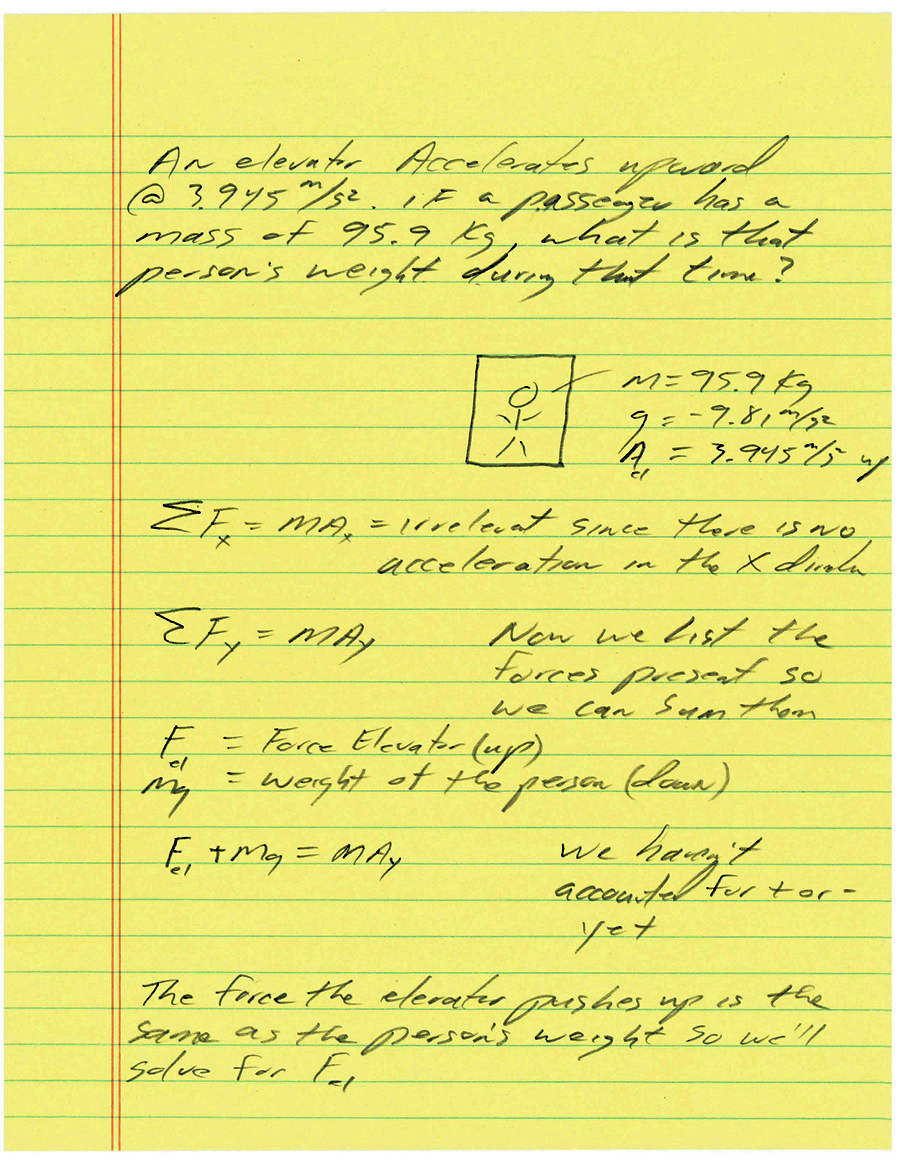
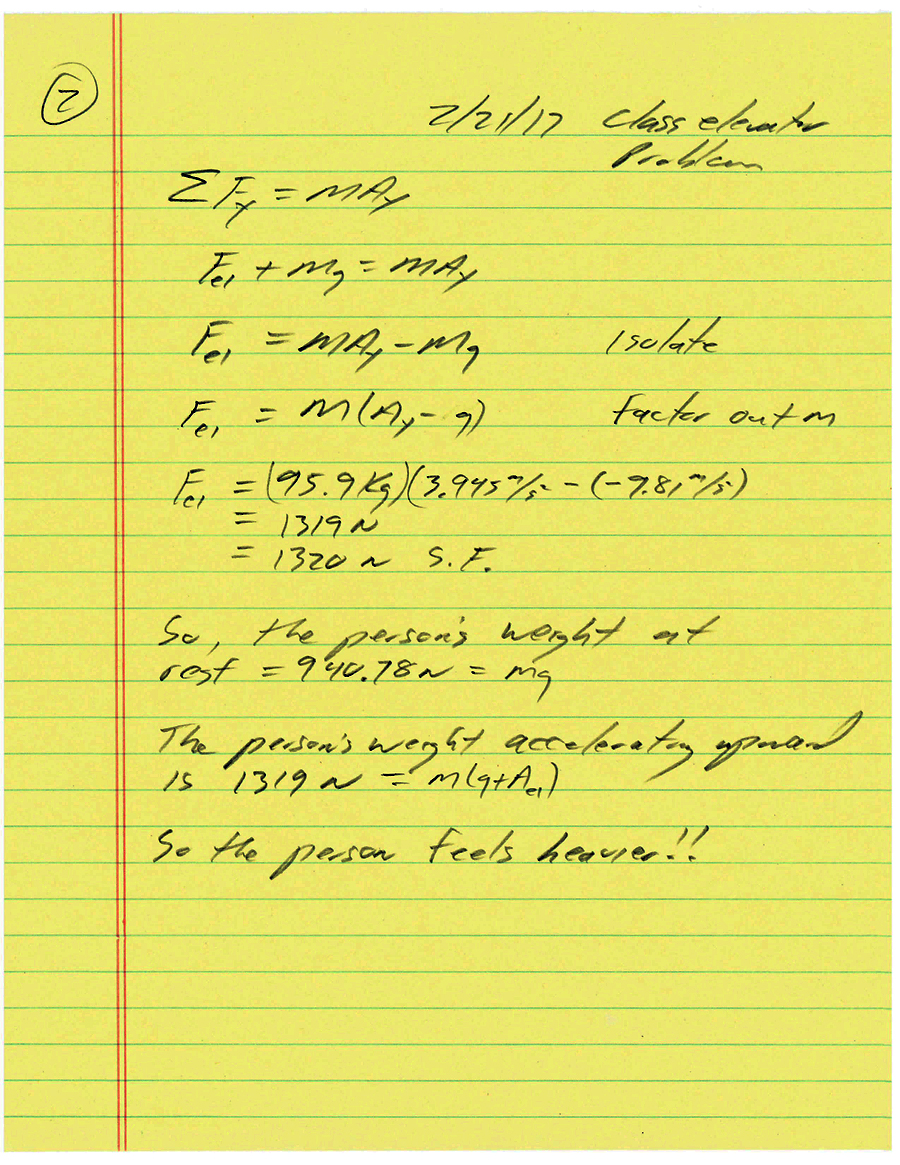
An elevator accelerates upward at a rate of 3.945 m/s/s. If a passenger has a mass of 95.9 kg and they conveniently happen to be standing on a bathroom scale that measures weight in Newtons during that time.
What weight does that scale show during that time that the elevator is accelerating at 3.945 m/s/s?
- Do a sketch
- Do a Newton's 1st Analysis
- Do a sum-of-the-forces description
- Solve
Here's a practice Hanger Problem for you to consider--
If you need a refresher on setting up hanger problems, please watch THIS
Consider a familiar hanger situation.
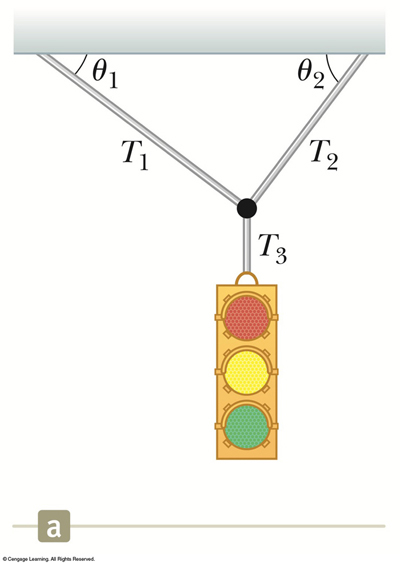
Please sketch that situation and label ALL component forces
Now let's say θ1 is 51.5o, θ2 is 35.0o, and T2 is 201 N
What is the horizontal component of force T2x?
→ (201N)(cos35o) = 164.6 N = 165 s.f.
What condition(s) MUST be present if T1x = T2x?
→Tthe light must NOT be accelerating horizontally
If the weight of the signal light is greater than T1y + T2y, what MUST occur?
→ The light would accelerate downwards
What is the value of the horizontal component of force exerted by T1?
→ it must be equal and opposite to T2x = 165 N
What is the value of T1?
→ T1x =T1cosθ1 => T1 =T1x/cosθ1 =265 N SF
Advanced: Prove to yourself that you can find T1, T2 and T3 if all you know are the angles (given above) and the mass of the object (let's say 59.0 kg). GO!
═══════════════════════════
Practice ramp problems:
PROBLEM #1 (Varsity - ish)
What is μ? ... and why do we care?
1) A 35 kg block made out of a certain type of wood is placed on a ramp made out of another type wood that makes an angle of 29 degrees to the horizontal. The coefficient of friction between the two surfaces is .25
Please Sketch that situation
Determine if the block will slide down the ramp. If it *does* slide down the ramp, please find the block's acceleration.
During your calculations keep an eye out for a mathematical reason why the mass of the block is irrelevant.
If you need a refresher on setting up hanger problems, please watch THIS (intro with friction absent)
Part 2 shows how to setup a ram problem when friction is present HERE
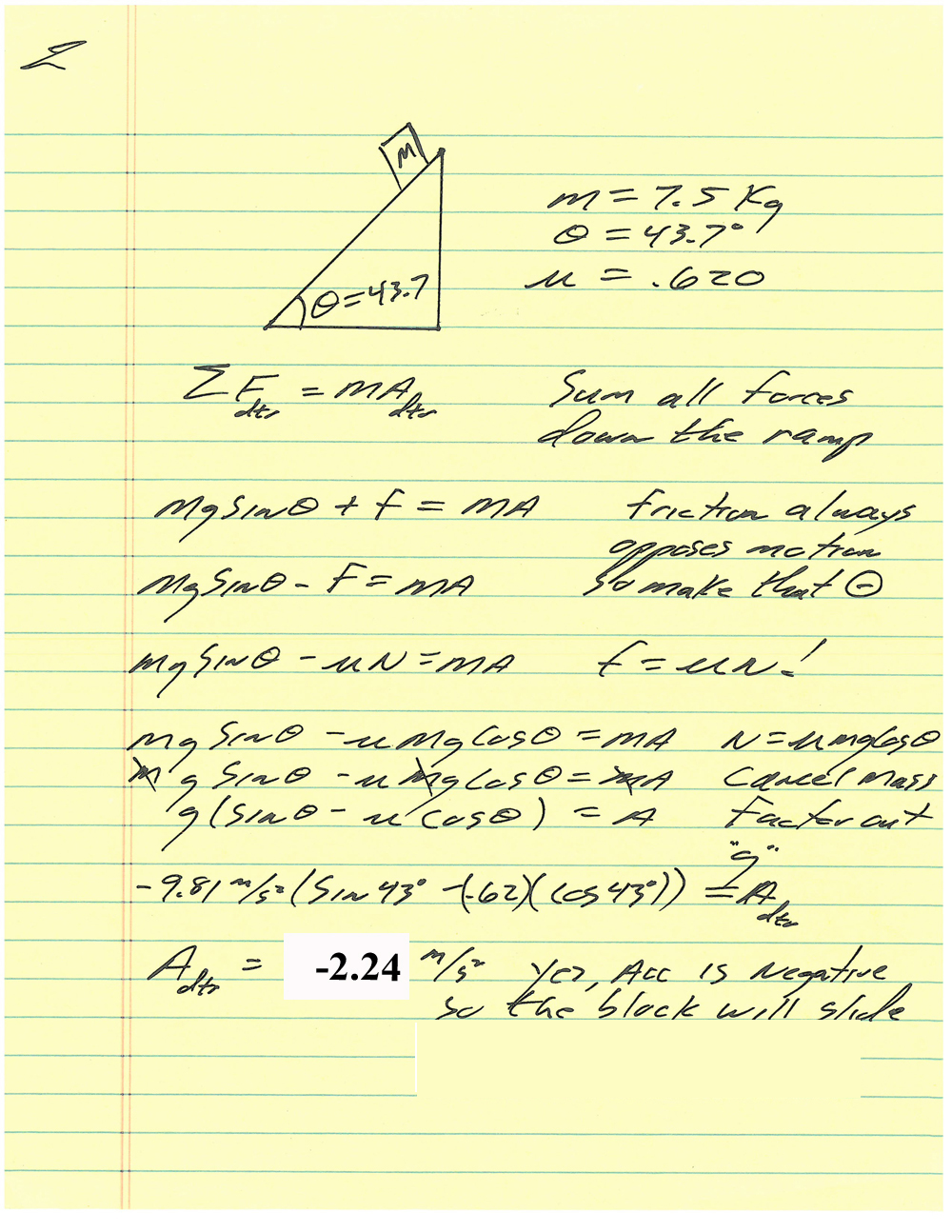
A 7.5 kg block made of oak slides down a ramp (also made of oak)
The ramp has an angle of 43.7 degrees to the horizontal.
The coefficient of friction for Oak vs Oak is .620
Will the block slide down the ramp?
Justify your response mathematically
ANSWER:
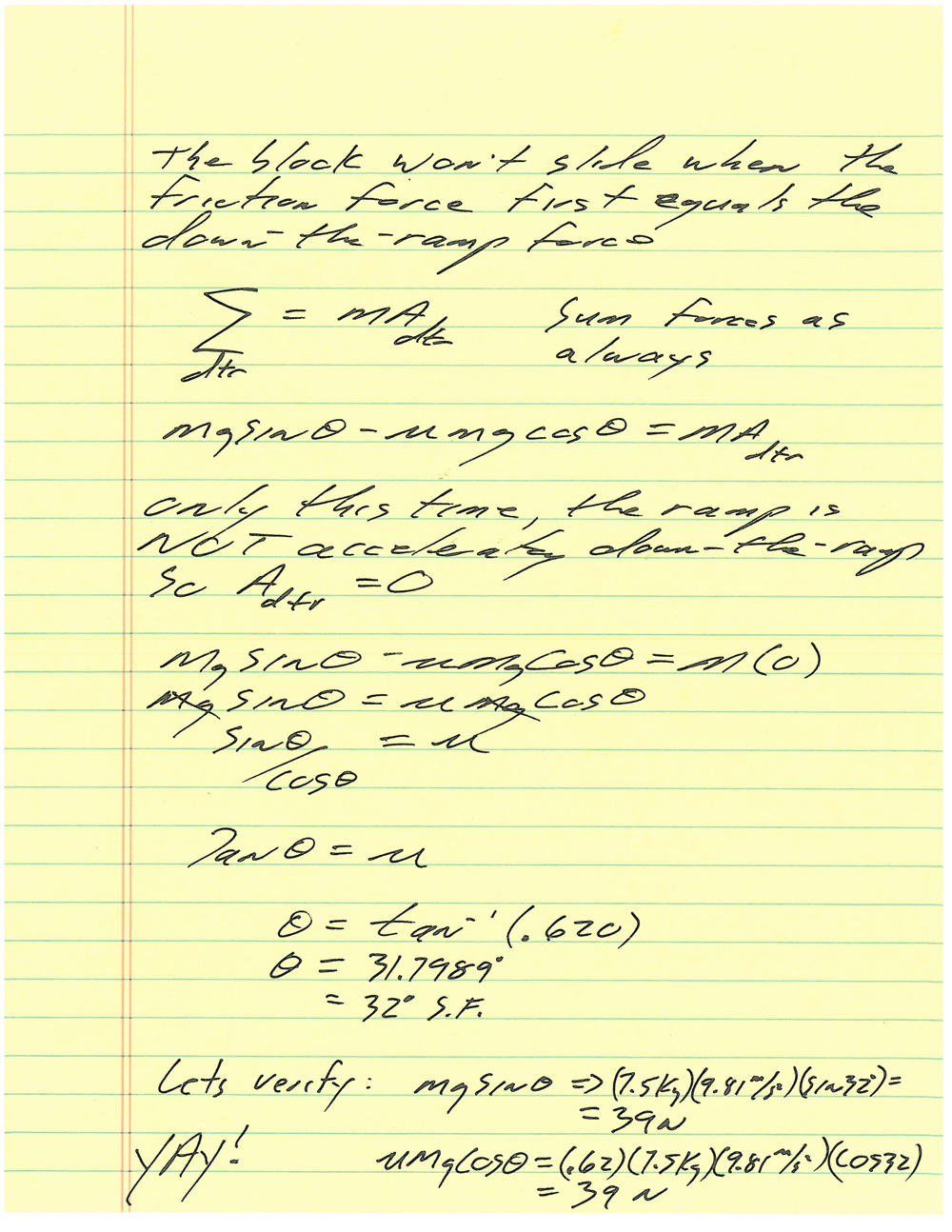
NOW: What please calculate the largest angle possible where the block would NOT slide?
- Sketch that situation and label all initial conditions
- Do a sum-of-the-forces analysis
- Think of the physics of the situation -- what MUST be present if the block is to remain at rest?