
OPENING QUESTIONS:
How much force must be exerted tangentially on a toilet paper roll of mass .98 kg with inner diameter of .5 cm and main diameter of 3.5 cm in order to get that object to rotate at 3.5 radians/sec2
OBJECTIVE: I will be able to apply the paralell axis theorem after today's class.
I will also be able to use the concepts of rotational kinetic energy after today's class
WORDS FOR TODAY:
- centrifugal acceleration (inaccurate)
- centripetal acceleration
- centripetal force (accurate but can be misleading)
- tangential velocity (flying off the disk (meters/second))
- angular speed (internal rotation (radians/second)
- angular acceleration
- moment of inertia (a means to determine rotation about a fixed axis)
CALENDAR:
DAYS ARE VERY SHORT
Your labs are due next Tuesday -- Your emphasis should be on explaining each ste pof your calculatios. DO NOT use math to explain the physics. Use real, whole world sentences. Remember, the goal here is to make it so an imaginary lab partner who is NOT present in the lab would be able to absolutely follow your work even if they were not present in class for the lab.
Error analysis as appropriate.
Do NOT include a graph.
Your ABB is due on Friday
and we still have a test on rotational motion & dynamics to chuck in there too (Thursday OR Friday)
BE MINDFUL OF YOUR TIME
FORMULAE:
There are a veritable FLOOD of new terms to get comfortable with in this unit... so let's start NOW:
Term |
Formula |
SI units
|
Description |
Notes |
radian |
θ |
radians |
2π (in radians) = 360o |
1 radian = 57.3 degrees |
period |
T |
seconds |
the period = time for one full rotation |
|
angular speed |
ω or ∆θ/dt or dθ/dt |
radians/sec |
velocity at any radial distance "r" of a rotating object |
angles ALWAYS described in radians |
tangential velocity |
v = ωr |
m/s |
linear velocity at any radial distance "r" |
|
centripetal acceleration |
ac = v2/r
or rω2 |
m/s2
|
acceleration of an object following a circular path |
Be careful -- radians (by definition) are unitless |
| Arc length | s |
measured in meters | ||
| angular acceleration | α |
d2θ/dt2 or dω/dt |
at = rα |
|
Linear Torque |
dFsinθ or RFsinθ |
nm |
d = displacement through which the force acts | Torque IS NOT WORK |
Rotational Torque |
RF |
nm |
R = radius through which the force acts | Torque IS NOT WORK |
Moment of Inertia |
various |
kgm2 |
see notes |
|
| Moment of Inertia | ∑τ = Fr = Iα |
|||
| Moment of Inertia | I =∫r2dm | kgm | ||
| PAX Theo | Ip = ICM + MD2 | |||
BUT WAIT!!! THERE'S MORE!
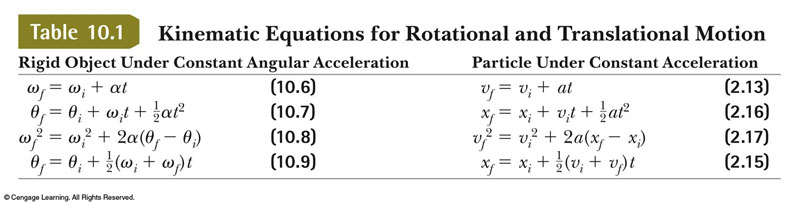
AND STILL MORE
WORK O' THE DAY:
The Paralell Axis Theorem states that if we know the MOI about an axis that runs through the center of mass, then we can easily calculate the MOI about a paralell axis:
Ip = ICM + MD2
where M is the mass of the object and D is the Distance between the c.o.m. axis and the paralell axis under consideration
Take a look at this video tonight... it's very helpful
HOWEVER, the author of that video rattles of a quick calculation to find the MOI of 4 masses separated by massless rods. It seems ridiculously easy.... Please keep in mind that the rods holding that object together are massless.
Also, the author of the video is basically using the definition of MOI to calculate the MOI for that special case.
Work through the example problem on page 310
═══════════════════════════
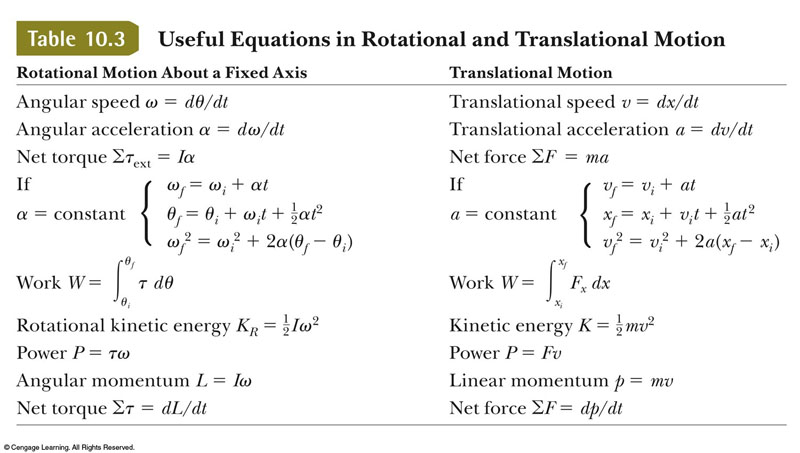
Now let's take a look at THIS graphic once again:
Take a few moments to get comfortable with the more esoteric terms... remember, although many of the linear formulae are present on your equation sheets, virtually NONE of the rotational analog equations are present there.
Now take a look at the worked example 10.11 on page 314 (the pi page?). Please note that although it isn't present in the question that the rod is in fact NOT accelerating at a constant rate...
If time permits, work through example 10.12
HOMEWORK: This is a tough set... also, remember we have your lab due on Tuesday, a test on Thurs OR Friday, and your AB due on Friday... it's awfully rough week folks!
Work through 10.12 if you didn't do it in class
Watch THIS
Problem 10.39, 41, 45, 47, 49, 53 (OUCH!)
STUDY GUIDE: